
THE PREFAB PEOPLE
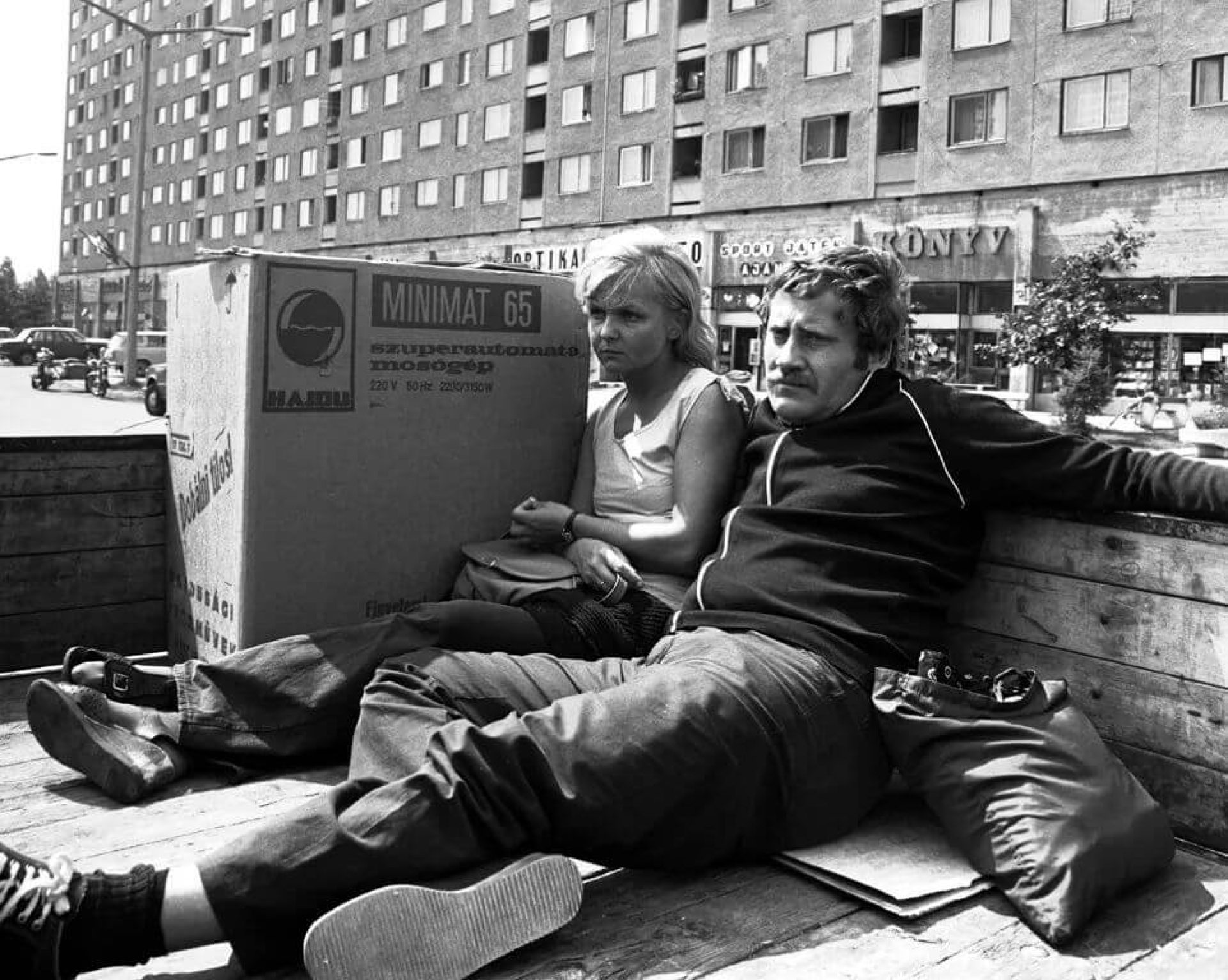
The final film in Béla Tarr’s “proletarian trilogy”, which began with Family Nest (1979) and continued with The Outsider(1981), Prefab People paints an intimate portrait of a generation and a social class. Episodes from the family life of a working-class couple, Férj and Feleség, unfold in a non-linear structure: an argument, a family breakfast, their eldest child’s homework, an evening at a restaurant, their ninth wedding anniversary, another argument, and so on.
The film’s circular narrative begins abruptly at the climax of the conflict between the two spouses. Férj packs his bags and announces to his wife, who is in the midst of a breakdown, holding a crying baby in her arms, that he is leaving. Feleség’s crying is neurotic, overwhelming, and inconsolable, revealing a profound inability to reconcile herself with the role assigned to her within the family.
Tarr employs an unembellished cinematic style, filmed in a manner reminiscent of cinéma vérité, with tight camera framing that contributes to the characters’ sense of claustrophobia and heightens their individual sense of helplessness.
The apartment plays a central role in the film’s dramatic structure: on the one hand, it represents the broader social conditions that define the protagonists’ possibilities in life; on the other, it serves as the intimate setting for the breakdown of their marriage.
In Tarr’s film, collective housing has the paradoxical effect of isolating families, each confined within its own prefabricated unit. Detached from any sense of neighbourhood, the story takes on a universal significance. We see apartment blocks, hundreds of identical flats, but no trace of community.
Screening presented in partnership with the Liszt Institute – Hungarian Cultural Centre Bucharest.
- Director:
- Béla Tarr
- Year:
- 1982
- Country:
- Hungary
- Genre:
- Fiction
- Duration:
- 71 minutes
- Language:
- Hungarian
- Subtitles:
- RO
- Screening:
- Friday, 6 November, Apollo 111 Cinema