
STEAGUL ROȘU: FROM NEIGHBOURHOOD TO METROPOLIS
Programme curators: Ana Szel (researcher), Andrei Rus (film critic), Alex Axinte (architect), Irina Tulbure (architect)
Moderators: Alex Axinte (architect), Andrei Rus (film critic)
The programme proposes a format in which the screenings are accompanied by a critical discussion. A researcher (Ana Szel), a historian (Corina Doboș), and an architect (Irina Tulbure) will each offer a possible interpretation of the film series. Their perspectives will address the director’s approach, the films’ subject matter, and some of the recurring themes explored throughout the programme.
The programme consists of three films, all centred on the Steagul Roșu neighbourhood in Brașov. Alexandru Sârbu, the director of the series, returns to the same place at ten-year intervals, carefully and empathetically observing the changes taking place in a neighbourhood that had only recently been inaugurated when the series began in 1956.
The connecting thread between the three films is their focus on a relatively consistent group of characters. Their personal stories provide a starting point for exploring demographic growth and the urbanisation of the area surrounding the industrial complex. Social advancement through education, presented as a process driven by the individuals themselves, is one of the recurring themes in all three films.
Nevertheless, each film approaches its central subject from a different perspective, introducing new nuances along the way. The first offers an optimistic portrayal of how workers spend their leisure time at weekends. The second focuses on technological development and increasing industrialisation as drivers of urban growth. Finally, the report made in the mid-1970s concentrates specifically on the neighbourhood itself, its functioning, and its architectural modernity.
Reportaj de la Steagul Roșu [Report from Steagul Roșu]
(1956, Alexandru Sârbu) – 18 minutes
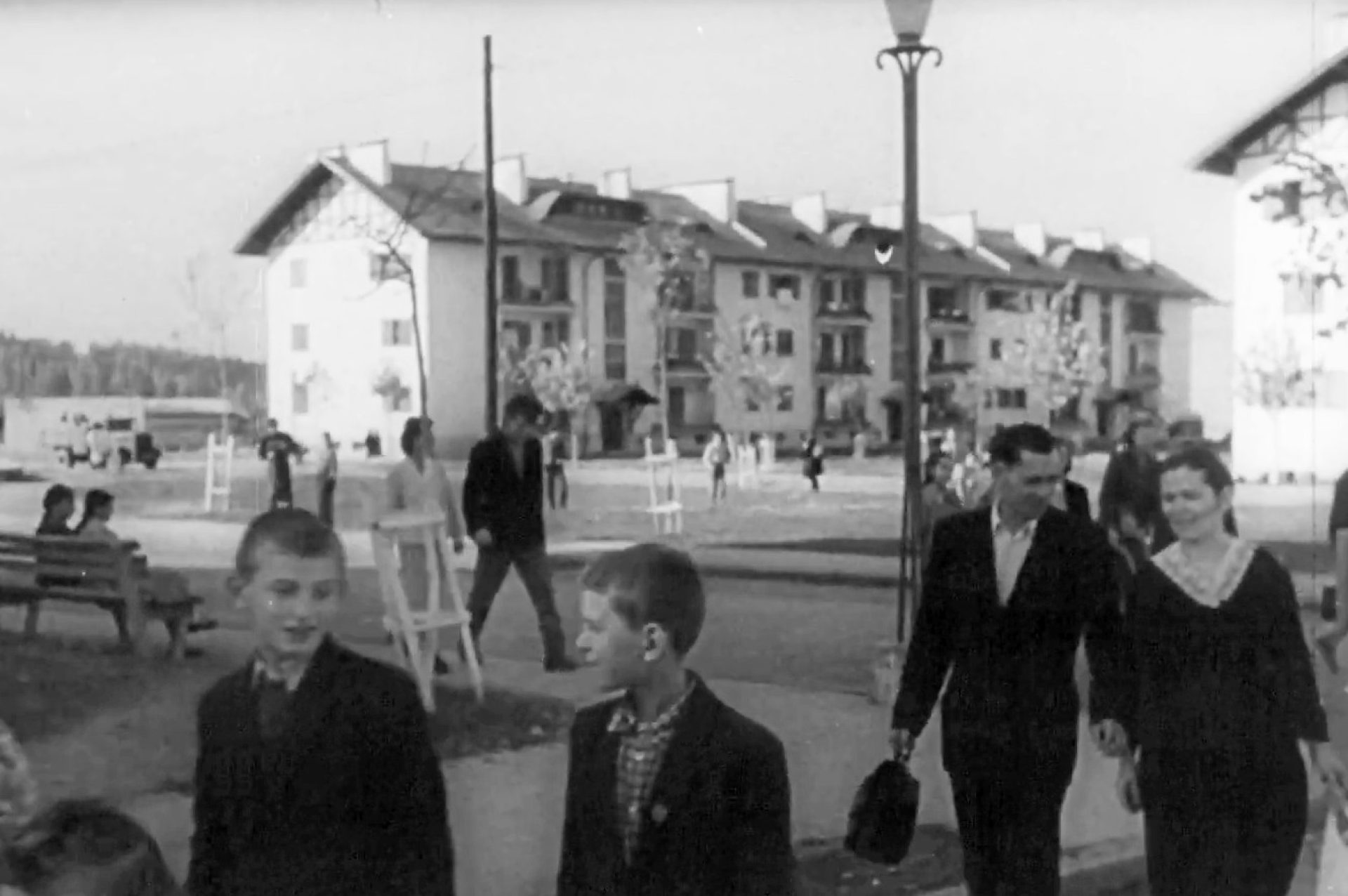
Contrary to the expectations raised by its opening sequences, which focus on the Steagul Roșu truck factory, the documentary captures weekend life in the small, newly built neighbourhood located immediately next to the plant.
The film offers a short narrative centred equally on the neighbourhood and its residents, who work at the factory. Collective housing, apartments, public spaces, and the first community facilities create the image of a small town, bringing the subject of urbanisation into focus.
Beyond the idealised image of the worker eager for education and culture, characteristic of the 1950s, the film offers surprisingly natural portraits of residents with a wide variety of interests and tastes.
Pe urmele unui reportaj [Following Up on a Report]
(1966, Alexandru Sârbu) – 17 minutes
Returning ten years later, the film captures a period of industrial expansion in Brașov. Production techniques at Steagul Roșu have changed, and new types of products are being manufactured. The industrial complex is expanding, and with it, the city’s built-up area.
Focusing on four individuals and their families, all of whom appeared in the original report, the film explores themes such as social advancement, education as the foundation of technological progress, and urbanisation as a guarantee of improved living standards.
Although not explicitly stated in the film’s narrative, architectural modernity is presented visually as an implicit expression of the modernisation of everyday life.
Orașul cel mare [The Big City]
(1976, Alexandru Sârbu) – 10 minutes
After three decades, the few apartment blocks that once made up Steagul Roșu have become almost indistinguishable within the vast landscape of the expanding working-class neighbourhood.
The film opens with several sequences featuring members of the neighbourhood’s third generation of residents. The passage of time and the presence of young people are two themes repeatedly emphasised by the reporter.
Urbanisation remains a central concern. The film captures both the neighbourhood’s physical expansion and the emergence of a wide range of facilities complementing residential life.
New, modern apartments in collective housing blocks accommodate different family structures, while the neighbourhood now includes commercial facilities (a shopping complex and a food market), educational institutions (two schools, a high school, and a technical school), and a performance hall.
Ana Szel
Ana Szel is a researcher, curator, PhD candidate, and teaching assistant at the “I.L. Caragiale” National University of Theatre and Film (UNATC) in Bucharest, where her doctoral research focuses on useful cinema in socialist Romania.
With an academic background in music and film, she is among the founders of a new master’s programme dedicated to the preservation and curation of audiovisual archives. She has worked with film archives since 2016, and her research interests include marginal filmmaking practices, silent cinema, and cinema as a field of interdisciplinary research.
In 2022, together with Christian Ferencz-Flatz, she organised the first international conference dedicated to useful cinema under state socialism, held in Bucharest. She is also co-editor, alongside Lucie Česálková and Christian Ferencz-Flatz, of Useful Cinema in State Socialist Europe, published by Routledge.
She is a doctoral researcher within the project Philosophy in Late Socialist Europe: Theoretical Practices in the Face of Polycrisis at Babeș-Bolyai University in Cluj-Napoca, and the PCE research project The Emerging Aesthetics of the Commodity: An Interdisciplinary Approach to Advertising Film in Postsocialist Romania at UNATC.
Andrei Rus
Andrei Rus is an Associate Professor at the Faculty of Film of the “I.L. Caragiale” National University of Theatre and Film (UNATC) in Bucharest, where he teaches film history.
He coordinates Arhiva Activă (The Active Archive), a project dedicated to digitising and presenting audiovisual archives from Romania.
For four years, he served as Artistic Director of the One World Romania International Documentary and Human Rights Film Festival. He also coordinated the film magazine Film Menu for seven years and, together with his editorial colleagues, organised regular screenings through the Film Menu Film Club and the Să Film! event.
He has curated film selections for Romanian film festivals, including Timishort and NexT, and has served on several festival juries, including the Revelation France 4 Jury of the Semaine de la Critique section at the Cannes Film Festival.
He was a film adviser to Ministers of Culture Vlad Alexandrescu and Corina Șuteu and served for three years on the Board of Directors of the Romanian National Film Centre.
Alex Axinte
Alex Axinte is an architect, researcher, and lecturer in the Department of Landscape Architecture at the Faculty of Horticulture, University of Agronomic Sciences and Veterinary Medicine of Bucharest (USAMV), and a New Europe College Fellow (2025–2026).
He holds a Master of Social Sciences (2018) and a PhD in Architecture (2024) from the University of Sheffield. His research focuses on informal practices of managing shared spaces in the context of collective housing in the post-socialist city.
He initiated and coordinated the Garaj DESCHIS project space (2020–2025) in Bucharest’s Drumul Taberei neighbourhood, which led to the research project Map of Neighbourhood Libraries (2022). He also co-edited Telling the Story. New Towns | New Narratives, published by INTI, Rotterdam (2025).
Irina Tulbure
Irina Tulbure is an architect whose work involves documenting, researching, teaching, and writing about architecture from the recent past, exploring how this heritage can be understood, reassessed, and embraced today.
She has been involved in various cultural projects, exhibitions, and summer schools dedicated to these subjects.
She is an Associate Professor in the Department of Architectural History and Theory and Heritage Conservation at the “Ion Mincu” University of Architecture and Urban Planning (UAUIM) in Bucharest. She was a Getty–New Europe College Fellow (2011–2012), collaborated with the Union of Architects of Romania on its photographic archive (2014–2017), and earned her PhD in Architecture from UAUIM in 2011.
She is the author of Architecture and Urban Planning in Romania, 1944–1960: Constraint and Experiment (2016).
Corina Doboș
Corina Doboș holds a PhD in History from the University of Bucharest (2013). She is a Research Fellow at the National Institute for the Study of Totalitarianism (since 2023), as well as an Associate Lecturer and Research Fellow at the University of Bucharest.
She holds a master’s degree in Nationalism Studies from Central European University, Budapest (2003), and was a fellow at the Imre Kertész Kolleg in Jena (2021) and New Europe College in Bucharest (2021–2022).
She is the principal investigator of the research project Increasing Labour Productivity: A Glocal History of Brașov During Late Socialism (GloBv.), funded by CNCS-UEFISCDI.
- Director:
- Alexandru Sârbu
- Year:
- 1956
- Country:
- Romania
- Genre:
- Documentary
- Duration:
- 45 minutes
- Language:
- Romanian
- Subtitles:
- —
- Screening:
- Thursday, 5 November, Cinema Elvire Popesco